Heretical Gaming is my blog about my gaming life, featuring small skirmishes and big battles from many historical periods (and some in the mythic past or the far future too). The focus is on battle reports using a wide variety of rules, with the occasional rules review, book review and odd musing about the gaming and history. Most of the battles use 6mm-sized figures and vehicles, but occasionally 15mm and 28mm figures appear too.

Sunday, 24 July 2022

Hobby Update 23rd July 2022

 Still not dead...but I have been pretty busy and pretty ill with COVID in the last little while, so hobby stuff has been intermittent at best; and hobby stuff has been less intermittent than gaming! Still, I have managed to get the odd thing done and the odd game played, so my hobby is still painting and gaming, rather than thinking about gaming!

The first project involved a little bit of painting but was mainly a re-basing exercise. I wanted my C17 pike and shot troops to serve equally well for the War of the Three Kingdoms and for The Thirty Years' War.  I had the standard bearers integral to the unit but what I did was take out most of the figures from the first rank, just leaving an officer and drummer, and then creating separate standard bearers on small circular bases to be placed in front of the unit.  It is not a perfect solution but it feels like a reasonable compromise between aesthetics, functionality and economy.

Anyway, some bases of Protestant Foot:


And some bases of Imperial/Catholic Foot.  Using some of the figures spare after the re-basing added to a few extra pike, I created some double depth Foot bases to represent the earlier, heavier tercios used by some of the Imperialist and Spanish forces in the TYW.


(All the above figures are Baccus 6mm).

Next up, there are some early WW2 French more-or-less complete.  The infantry are from Forged in Battle, the vehicles are from QRF.


 As long-suffering blog readers will know, I use 15mm and 6mm for my WW2 gaming, depending on the scenario.  There are some 6mm Early War French, with the figures from Adler and the vehicles and 25mm anti-tank gun and crew from Heroics & Ros.


I have also picked up a few additional items for early WW2 British: a few Matilda Is, a few Vickers VI light tanks and a few Boys anti-tank rifles.  These are all from Heroics and Ros.


Continuing the Early War theme, here are some 15mm WW2 Poles: again, infantry mostly from Forged in Battle, vehicles and anti-tank riflemen from QRF.


And yet more WW2: I have managed to get some paint on some of the 1/300 Plastic Soldier Company Battle of Britain aircraft - some Hurricanes and some Bf109Es.


The 6mm WW2 Germans got some extra LMG teams in smock:


 And I also picked up my first buildings (as far as I remember anyway), from Battlescale Miniatures.  These are really rather nice!  And of course, you cannot really have too many buildings...I will be getting more.

From L-R: a Culloden croft, a rendered farmhouse,  a water mill, a rural house with annex, a dunker church and a ruined terrace,


And a couple more bits of 15mm WW2: Germans with anti-tank rifles from QRF.


So I haven't been entirely unproductive, but there is still (for me) quite a lot on the painting pile.  Off the top of my head, I think it looks like the following:

Some 28mm WW2 British Paratroopers (these are for my son rather than myself)
Some 28mm Frostgrave Barbarians
Some 28mm Stargrave Crew
Some 28mm Skaven
A few 28mm Vikings 
Some 6mm WW2 US vehicles 
Some additional 15mm vehicles and figures for Cold War Gone Hot/Twilight 2000
Finish off the batch of 1/300 Battle of Britain aircraft.
A few additional 6mm Vietnam War extras (both US and VC)
There are also some 6mm Napoleonic French (these are for adding additional French Allied units, as and when I need them).

There isn't much on the shopping list at the moment, since the above lot should keep me busy over the summer until the early autumn shows.  So FWIW it looks something like this:

Some more 15mm Cold War Gone Hot/Twilight 2000 figures (East German infantry, West German infantry)
Some additional items for early war WW2: particularly some additional tanks, reconnaissance vehicles and anti-tank weapons for the Germans, although the French and British could use a few more too.  Plus I really need to to think about my WW2 collection in terms of basing and organization and stuff.

I don't think there is much else that should go on there at the moment, although I do have quite a lot of ideas for the next batch of projects.  But I want to get these ones done first.

Saturday, 16 July 2022

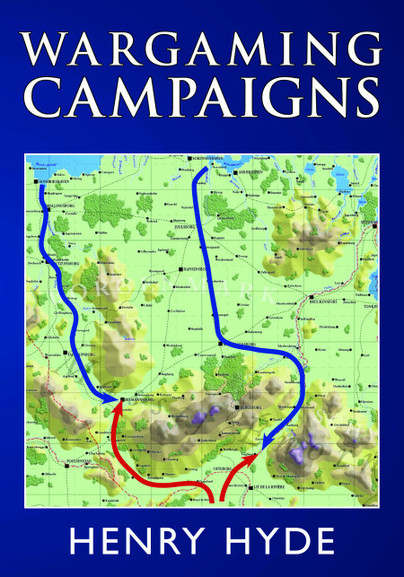
Wargaming Campaigns by Henry Hyde: A Review

 This week's reading material has been Henry Hyde's new wargaming magnum opus, Wargaming Campaigns.


It is a long book and it might best be thought of as a wargaming campaigns compendium, trying to give the most comprehensive coverage of the subject yet in print in English. Whatever else it does, it succeeds in this aim.  If a reader has a mental checklist of campaigning then the chances are that this book will tick off each box. It gives reasonable answers to everything from "what is a wargames' campaign and why do it?" to "which are best social media tools out there to help me run a modern online campaign?".

This book refers to all the previous books on wargames campaigns that I am aware of, although naturally some are referred to more than others.  In spirit, although Hyde is very much a 'Grant'-man, his book is much more like Don Featherstone's Wargaming Campaigns in spirit and execution than Grant's Wargame Campaigns. Is the use of the same name as for Featherstone's book a nod to this?


This is because Hyde's Wargaming Campaigns, like Featherstone's book, is much more wide-ranging with little snippets on each facet of campaigning and giving inspirational ideas rather than Grant's more focused effort, which concentrates on how to do a 'traditional' wargames campaign in some depth.  That said, Hyde's work is much bigger than either so in a sense, has space to combine the two.

So, what does the book contain? It tries to describe wargame campaigns and explain why they are fun but also, importantly, why they can be hard work and why they fail. Next is an extensive treatment of what to consider in terms of putting together rules and scenarios for wargames campaigns. The numerous different possibilities of how to 'structure' campaigns are all described as are the different experiences which they lead to, for example from the simple structured and unstructured 'ladder' campaigns and 'battle leagues' and narrative campaigns to very detailed efforts with detailed geographic and economic models behind them. As might be expected from this author given his extensive interests in using imaginary armies and countries in his wargames, different methods of creating maps for wargaming are given a very extensive and useful treatment.  It is pretty much authoritative, I would be surprised if anyone not a real specialist would need more than is provided here. Less expected but very usefully, the treatment of weather and climate is nearly as extensive with some simple but neat mechanisms for using it in campaigns and in the tactical battles it generates. I think the only thing that is missing is more ideas for actually physically representing weather, ground and light conditions on the gaming table itself, although a nifty game aid is proposed.

The author freely admits that in his own campaigning he has sometimes gone down some background rabbit holes which had more to do with fleshing out and wallowing in the detail of his own authorial creations than would be strictly necessary for wargames' background information.  In some quite neat writing, he manages to both warn the unwary of the dangers of this and give helpful signposts to those who want to follow a similar path.

There are two main sets of campaign rules given by the author: a simple set focused on two sides in a relatively small area and another very comprehensive set aimed at 'everything' on land from the beginning of the Chariot Age to c.1900, although it could be used for later warfare as well.  The rules look absolutely fine and I have used a version of them previously for a short campaign: it falls into the 'relatively detailed' category, but works fine.  Where I think the author might have said more is on the translation from campaign map to wargames table and back again. I know from experience that this is a crucial part of successful campaigning and one of the main areas where a promising campaign can become unstuck.

As a wargames writer who doesn't want to neglect fantasy and science-fiction facets of both are discussed and the former has its own campaign with specific rules. This latter is a development of a scenario he had previously written and published in Miniature Wargames.  It is also designed to showcase the benefits of smaller campaigns focusing on a relatively small number of combatants and the personalization that can bring.  Even smaller 'squad-level' campaigns, or those focusing on a single ship or pilot, are mentioned but not developed as much.  Solo campaigning is given quite comprehensive treatment though, so much so that it isn't put into a separate chapter but is referred to constantly throughout the book.

There is a very extensive section on including personality in campaigns, with some rules to support this.  They are conceptually simple in that there are a number of personal characteristics which are generated by rolling d100 and then this is tested as a percentage or used as a bonus in certain circumstances.  It seems to work okay although it does seem to generate quite 'extreme' characters: I think the system might work a little more smoothly if a player used 2d6 to generate the numbers and do the tests.  I might also apply minima to some of the characteristics on the grounds that some personal characteristics might be disqualifying for certain roles.

Naval and air campaigns are covered, although the emphasis is largely on land actions.  The naval chapter was rather good, containing enough information for a newcomer to have a go at setting up a reasonable campaign or at least including naval actions in a land-centred scenario. By contrast, the air warfare stuff I felt was one level less detailed and felt like a more high-level overview of possibilities and considerations.  I think anyone interested would be better advised to find a copy of Mike Spick's Air Battles in Miniature, although to be honest I still think there has never yet been a really good campaign guide for WW2 and later combined operations.


By contrast, the writing on sieges - which are conceived of both as a process to be included in a campaign and as interesting campaigns in themselves - is outstanding and authoritative; in a way, Henry Hyde is competing with his own magazine articles for that position in the wargames pantheon since I know of nothing else as good, in particular if one is focused on C17-early C19 sieges.  I suppose the section in Quarrie's Napoleon's Campaigns in Miniature is reasonably good too, thinking about it. 

The author writes extensively about the development and current state of the media which can be used to support campaign play. This covers everything from the design of the materials (maps, game records, game aids) to the media used to communicate with players and the vices and virtues of each. This is reasonably extensive: the possibilities inherent in various media like Discord or Twitter seem to be quite inspiring for the author and I don't think there is anything better out there.  It would be very useful for any readers considering taking on the projects in or similar too Paddy Griffith's megagames, and for gamers planning Play By E-Mail or other modern forms of multi-player campaigning.


The book  also describes in some detail several campaigns, so the reader can get some idea of what this all looks like in practice.  These include some of Henry Hyde's own campaigns, a Charles Grant campaign, a kriegspiel-esque game run by the Too Fat Lardies, part of the legendary 'Hyboria' campaign and a Ron Miles' extended siege. There is also a Steve Jones' 1809 Danube campaign scenario, re-printed from Miniature Wargames magazine I think, which looks absolutely superb: it has been on my own to-do list for a little while! 

The tone here is quite infectious and the writing, although very good throughout the book, comes into its own here as the reader is slightly swept up in it. That said, although the author references some other types of campaign and provides links to them (including a couple of links to my own efforts amongst many others - many thanks to Henry Hyde for that), there is naturally much less emphasis on these. I don't mean this as criticism since an author will naturally default here to those he or she has most knowledge of and interest in compared to, say, a 'Tour of Duty' campaign set in Vietnam in 1966 featuring a single US Army platoon, or some such; but it is probably worth noting that compendious as this effort is, there are still many areas worth exploring. Using boardgames as a base engine for campaigns is mentioned, for example, and I have used them extensively myself; and another author might have laid more emphasis on these and the how-to of using them.  I think all I am really getting at here is that Wargames Campaigns as a subject, because of the time they take to set up and play, are almost beyond any individual author having extensive experience of all of the various forms.  But not the least value in this book comes from its really extensive links and references: the author has obviously taken great pains to link and signpost to a large number of resources and campaigns which demonstrate a huge variety of campaign ideas, scenarios and techniques that gamers use.

I thoroughly enjoyed this as a read. When I review wargaming books I will normally only do it after a play or two at the very least, but that would probably be too high of a standard for a book on campaigning, so I have treated it more as 'a book' than 'a game'.  It forms a nice companion to his first book, The Wargaming Compendium


I don't think it would replace the classics of the past for all readers, all of which focus on particular areas in perhaps more detail than this does. But as the ultimate collection of ideas and pointers and examples, this is the clear leader at the moment. The writing lets the author's enthusiasm and knowledge shine through whilst remaining clear.  I read the electronic version so I can't comment on the infamous 'heft' of the book, but the design is modern and a model of current style, although the writing style seems self-consciously somewhat modeled on that of Charles Grant...

Heretical Campaigning - A Note:

The book has inspired me to think more about campaigns and how to do these better myself.  It has also inspired me to think a little more about where the gaps are in terms of wargaming literature on campaigns.  I mentioned earlier that I think one of the obvious ones is to do with WW2 Combined Arms campaigning. I don't think small-unit campaigns, especially by sea and by air, have yet been developed by the community as far as they might go. I think that there might be room for a more structured and detailed approach to the political super-structure of wargames campaigning thought of as a more usual game rather than a form of free(-ish) kriegspiel or role-playing game. It was great that this book spoke to both sides of the fuzzy, but definitely existing, line between the 'historical' and 'fantasy' camps of the hobby but I think the latter is much less well served in terms of writing about campaigning even though the subject is, if anything, even more suitable for it: after all, Waterloo has an attraction of its own even outside of the 100 Days. 

But most of all - it is inspiring me to get something on the table as soon as may be!


Monday, 4 July 2022

Joy of Six 2022

 Joy of Six 2022

I headed up to Sheffield yesterday for the Joy of Six show, the first time this show had happened (as a physical event) since 2019.  


It was the biggest version of this show, with more traders and games on than in previous years and occupying more physical space.  It seemed reasonably busy without being heaving - maybe 300 people or so?

I think was put on by the Deeside Defenders?  Anyway, it is an Iran-Iraq War game (Khorramshahr 1980 which featured the Iranians trying to stop the Iraqi advance. Seemed quite interesting, with a hidden 'zonal' overlay as part of it for unrevealed units and fire support - you can see it just on the map (top-right))


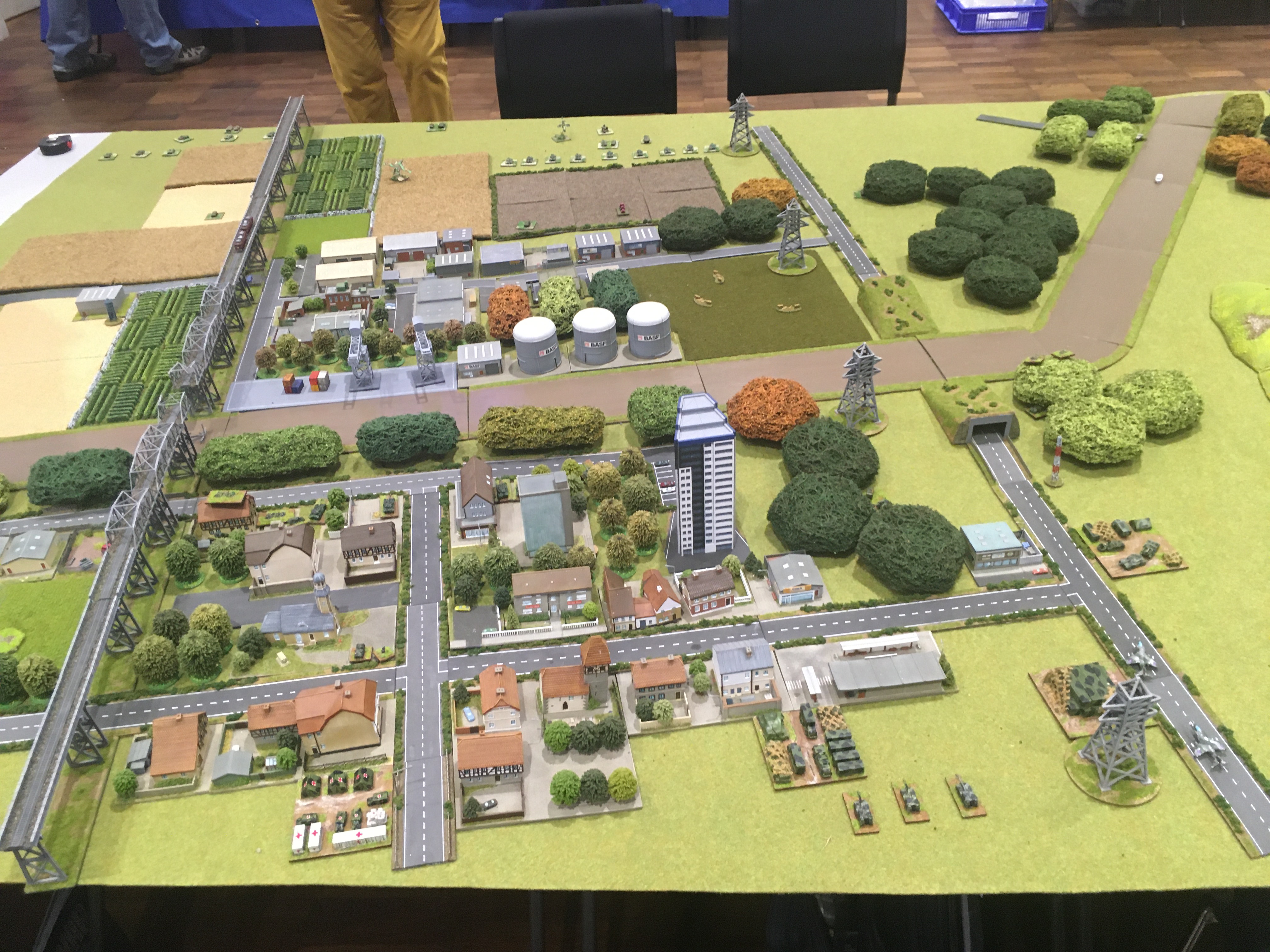
The second modern game was a Cold War Gone Hot 'Denmark 1985' scenario, put on by the Cold War Commanders, which was a mixed participation and demonstration game - an innovative concept!  The table was absolutely huge - this shot is of the 'demonstration' bit, featuring the enormous raised rail bridge on the left. Naturally the game was using the Cold War Commander rules.

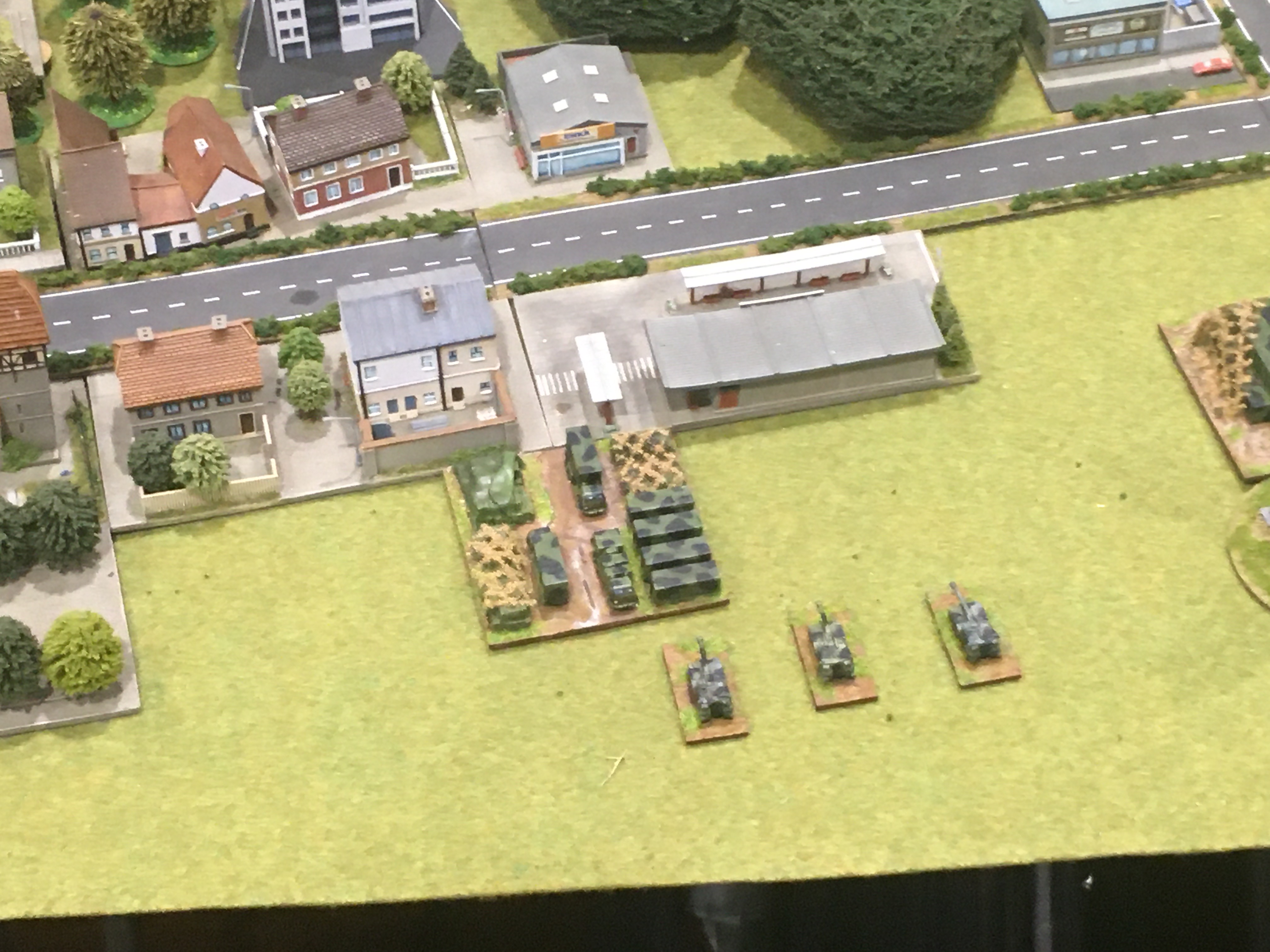
A closer view of the British defenders.  The big square base represents an HQ element.

The other bit of the table - the 'participation' area is at the bottom (i.e. right) of the table.

This game was put on by James Mitchell, he of the 'big games on small tables', think this one was called 'Sudan Death...'.  I thought this one looked great and very much the kind of thing I could/should aspire to.

Lots of lovely figures on quite a small board.  Love the way even the edge of the mat adds to the aesthetic feel of the game too!

Another view.

Another absolutely huge game by Daniel Hodgson - this was Little Big Horn played on Hexon terrain, using the new Baccus 6mm Pony Wars' range.  Very nice and Custer was doing rather better in the game than in history when I popped along.

Another shot.

To show the detail of the game, I just picked the closest corner but honestly I could have picked from six or seven areas of the board to show different but equivalent scenes.

Some Mounted Warriors cross one of the fords

A Native American settlement

Where the action is!  Nice smoke, not too many markers.

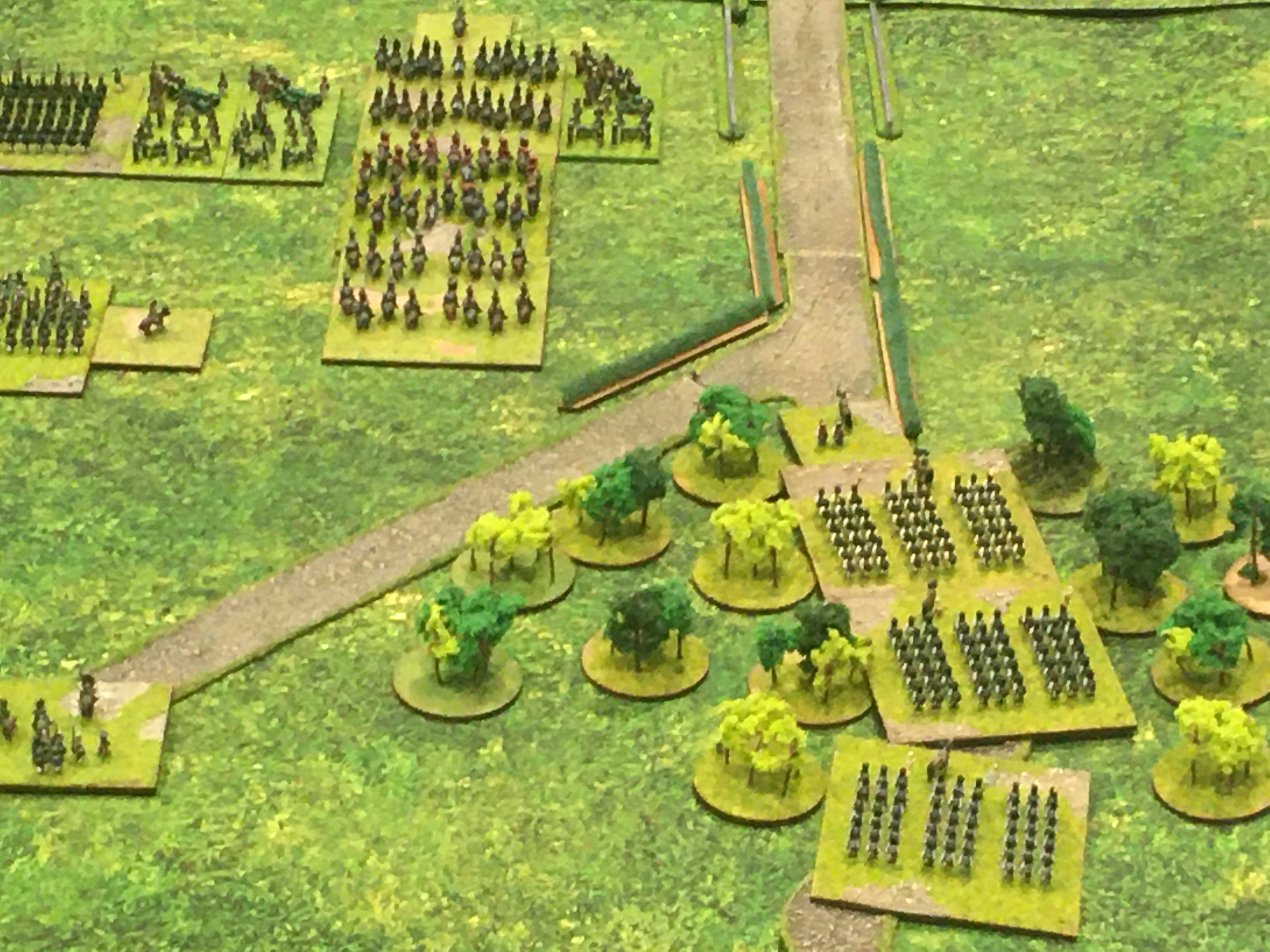
A Bloody Big Battles' set-up; I wish I had been able to speak to the game presenter,  I would have liked to discuss the rules and game design in more detail since this one looked do-able for me in a way some of the other games didn't.  And BBB has been on my 'must get around to trying' list for quite a long time now.  It was a Hungary 1849 scenario, which you don't get to type very often in this hobby: the Battle of Isaszeg.

Big printed map, relatively small number of figures (so lots of room for interesting manoeuvres).

A closer view of how the troops interact with the map.

And another. I guess if I were concentrating on doing this kind of battle, I would probably use painted rather than flocked/static grass bases.

The Commission Figurines Napoleonic display, using their 6mm wooden figures.

Another shot.  It does work really well and if I were a gamer on a strict budget I would start here. I was quite tempted to get some ACW figures but there are a couple of other projects I want to push on with first (not finish. never 'finish') before I tackle that.

A closer view...

And another. It is only when you get to this range when the figures start to take on the slightly more 'boxy' appearance.

Another game emphasizing the 'small table - big battle' concept: this time it is Gettysburg, again using Bloody Big Battles.

A bit closer in.  Another very do-able game concept.


Chaironea by the Society of Ancients, the first of some very nice DBx games at the show: this one is Big Battle DBA (36-bases per side). BBDBA is a very effective way of doing the small table/big battle thing and it plays really fast.  I believe that they had time to do this one twice during the day, which is good going for a game at a show.


Another shot.

I think this was a Roman-era Strength and Honour game. I didn't really get the details since it always seemed to be quite busy when I was strolling past - maybe Nikopolis? But, it looked great and everyone seemed to be getting into it.

Another shot

And a closer view of the fortifications: I love this kind of stuff, I should really make some more of these king of things for me.  There was another Strength and Honour game in 2mm, which I unfortunately didn't get a picture of.

This is a WW2 'Operation Crusader' game - possibly one of the most confusing battles of all time - re-set to the Modern-era and using (I think) the Fistful of Tows rules. I should have spent more time here, since I have no idea what these rules are all about, although I have heard of them before.

Anyway, it looked like a good, solid microtanks' game. Good vehicles and functional but nice terrain.  Another one in the 'steal' pile.

And another shot.


Per Broden's Scanian War game, the Battle of Lund, using Baccus 6mm figures and the Twilight of the Sun King rules.

As I hope you can see, it looked great. Per's games consistently evoke not just a place but a season; the snow effects look great.


Magic!

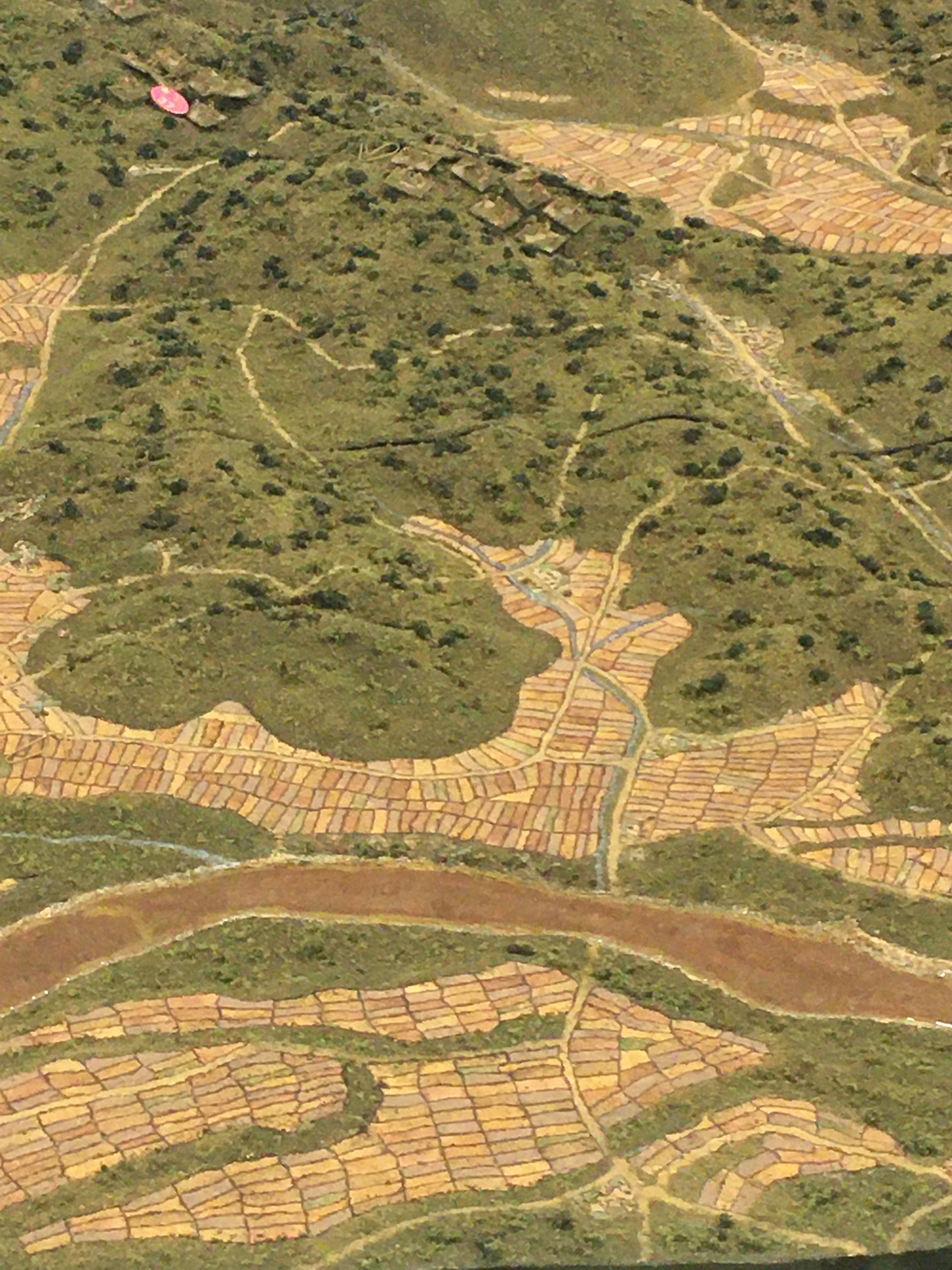
Very evocative terrain for the Battle of Imjin, by Charles Rowntree.  The troops really blend into the terrain to create a very naturalistic feel. I played this at Partizan, a very interesting and justly-lauded scenario.

I didn't get a shot which truly does the relief justice, but this perhaps gives some idea.

Another shot, just because.

My phone-camera slightly struggled here, but hopefully this gives an idea of what things looked like at the point of action.

And another lovely view.  The only thing I will say is that the more naturalistic the terrain, the more visually-jarring game markers can be.

 A Normandy 1944 game - the Battle for Hill 112.  This is using the 'All Hell Let Loose' rules which are apparently scalable for different levels of WW2 conflict. Nice vehicles and terrain pieces in this one, and one of the presenters kindly talked me through how they add vehicle aerials!


Another shot.

And closer into the point of action: the markers are less obtrusive in this set up.

And again.

Another Big Battle DBA game, put on by COGS: this one was Catalunian Fields and very nice it looked too.

DBA has a particular flow to it, but gives a fast game.


Recoil moves and pursuits break up the lines!

Apologies, I didn't get a great angle on this game for some reason. But it was another game from COGS, featuring the ECW battle of Roundway Down using Heroics and Ros figures.  You can just see some bases off the edge at the bottom of the picture - the bases are quite flexible, with pike and shot and command blocks fitting separately into the bases, which IIRC are 3D-printed. They worked really well and obviously give lots of flexibility to re-skin a unit from the ECW to the TYW and so on.

Another view: the Parliamentarians were doing rather better in this refight!

And again.


And last of the games I got a picture of, this one is a very large DBMM game. Again, I have forgotten the name of the battle but lots of lovely chariots featured!  This one was put on by the Milton Keynes' team. I had a very interesting chat with one of the presenters about the virtues of DBMM, the development of ancient rules, Phil Barker's approach to rules-writing and so on. It was an interesting day in that I was part of two conversations, one with a Phil Barker fan and one with someone who wasn't! I am much more in the 'fan' camp - I think a lot (but not quite all) of the criticism is unjustified, and it says something quite positive that the DBx system was the one most represented in the Joy of Six games yesterday.

I think this is a great Ancients-battle scene.

Sorry the photo isn't great but this is of the infantry battle in the centre.
 
I missed taking workable photographs of a few games: a lovely MAD-gamers 'War of the Worlds' 1890s game; a bijou but interesting looking tank-hunting game; and a small campaign game of Henry V's 1415 campaign (but using 6mm figures for the forces involved). There was also a very nice collection of well-modelled 6mm inspiration pieces.

I had been looking forward to speaking to Sean of God's Own Scale and seeing his Guilford Courthouse game but unfortunately he got COVID and wasn't able to attend. I was also vaguely expecting to see a really big WW1 game but if it was there I missed it! Which will be embarrassing, since it was probably on a 20-foot table that I ended up walking straight past...

It did inspire quite a bit of thought for me on the way home. I haven't reached any very definite conclusions but in no particular order:

1 - Table clutter (I mean markers rather than cans of pop) can quit easily break the visual 'spell'.

2 - Large game demonstrations show lovely-looking large set-ups but don't necessarily show you how to stage a large game, where you want to play that game to a finish (although one answer to this seems to be play DBx, which will get you to the end quite quickly!). The Strength and Honour games seemed to roll on quite quickly too.  I guess more broadly I am thinking about when you would want to put on a 'big' game and when you want to change the scale of the figures and rules instead to get a big battle on a small table. It also applies to how many individual bases you would want on the board.

3 - There are lots of ways to make 6mm games look really good - they are almost entirely about terrain and basing rather than the painting of individual models.

As usual, there were two discussion groups, one about Baccus things in the morning and one about the hobby more generally in the afternoon.  The latter was very busy and featured Dan from Wargames Illustrated, Greg from Little Wars' TV and a podcasting chap whose name escapes me at the moment - Guy from WSS ended up getting involved quite a lot too! But they were all very good and apart from the first question (the hardy perennial of getting more 6mm articles and photographs into wargaming magazines) the discussion was of questions that were a bit different from the last couple of times that this was done: the impact and future of the geographical expansion of the hobby, the impact of various media forms on the hobby and its demographics and so on.  The Baccus' Q&A as ever was quite useful in hearing Peter's thinking about future developments.  He was saying that NW Europe 1944 will be finished very soon, followed by the Soviets for 1944 and 1945. After that, he was planning on pivoting to the Western Desert. For other ranges, Poles for the GNW, a Great Italian Wars' range and Byzantines for the Crusades-era were mentioned, plus the continual review of ranges for moulds which were becoming more worn out.  He did stress though that the size of the WW2 range would be quite a dominating feature for the next few years.  The calls for 'more fantasy' from the hobby panel in the afternoon and Peter's reaction were quite amusing...

The traders seemed to be doing quite a fair level of business for most of the day. Of the main 6mm ranges that were absent, there was Adler, Total Battle Miniatures, anyone selling GHQ, Microworld, Vanguard, Perfect 6 and Leven - also the Polish guys whose range I forget weren't around (they of the nice ACW figures); conversely it was nice to see Irregular Miniatures and 2d6 Wargaming for the first time. I had heard that Grumbler Miniatures were going to be there but I didn't notice them - not sure if that was me and I just missed out! So there is still plenty of room for the show to expand.
 
Anyway, I got a few bits and pieces to keep me going in the summer: some Vietnam War stuff from Irregular, a few Battlescale buildings, a couple of different Soviet AFVs from 2d6, a few figure packs from Brigade and a mixture of some Early War WW2 (French and British) and some Cold War British and Soviet stuff.  I tried to get some Scotia Polish but unfortunately they didn't seem to be carrying any that day! Same deal for 2d6 Wargaming's Meditteranean theatre WW2 Brits...There were probably a couple more things...I had meant to get a couple of things from Baccus but I never seemed to find a quiet enough time to get them - one for the post next month, perhaps...
 
Anyway, it was very nice to get back to the JoS show - had a good day, it was nice to chat to a few people I hadn't seen in a while.  It did seem to have a nice 'buzz' to it, possibly helped by having the Little Wars and Too Fat Lardies' teams there for the first time.