Heretical Gaming is my blog about my gaming life, featuring small skirmishes and big battles from many historical periods (and some in the mythic past or the far future too). The focus is on battle reports using a wide variety of rules, with the occasional rules review, book review and odd musing about the gaming and history. Most of the battles use 6mm-sized figures and vehicles, but occasionally 15mm and 28mm figures appear too.

Monday, 15 April 2019

Battle of Tornavento 1636: a Twilight of Divine Right AAR

Battle of Tornavento:
I played out another battle from 1636 in this series of refights of Thirty Years' War battles using the Twilight of Divine Right rules and its accompanying scenario book: the Battle of Tornavento.


This time the action shifts to one of the peripheral theatres: Lombardy.  This battle features a Spanish attack on a slightly larger Franco-Savoyard force but with an element of surprise which seems to have caused a degree of temporary paralysis in the French command...the Spaniards have to defeat the Franco-Savoyard force to win.

The Forces:

Franco-Savoyard Army:
C-in-C: Vittorio Amedeo

Defending the Fortifications & Village:
6 units of Foot
2 units of Horse
1 unit of Dragoons

Main Body:
9 units of Foot
3 units of Horse
1 unit of Guns

Spanish Army:
C-in-C: Leganes
10 units of Foot
8 units of Horse
1 unit of Dragoons
1 unit of Guns

(as ever for this period, the 'Spanish' army contains a fair admixture of Germans and Italians too...)

The Franco-Savoyards have to roll to start their main body moving.  Their troops may only move over the bridge a single unit per turn (although they don't have to move in column).  The river is only crossable at the bridge.  The Spanish infantry units arrive first in two columns (with a couple of units of Horse in support), then the main body of the Spanish Horse comes after.

The Set-Up:

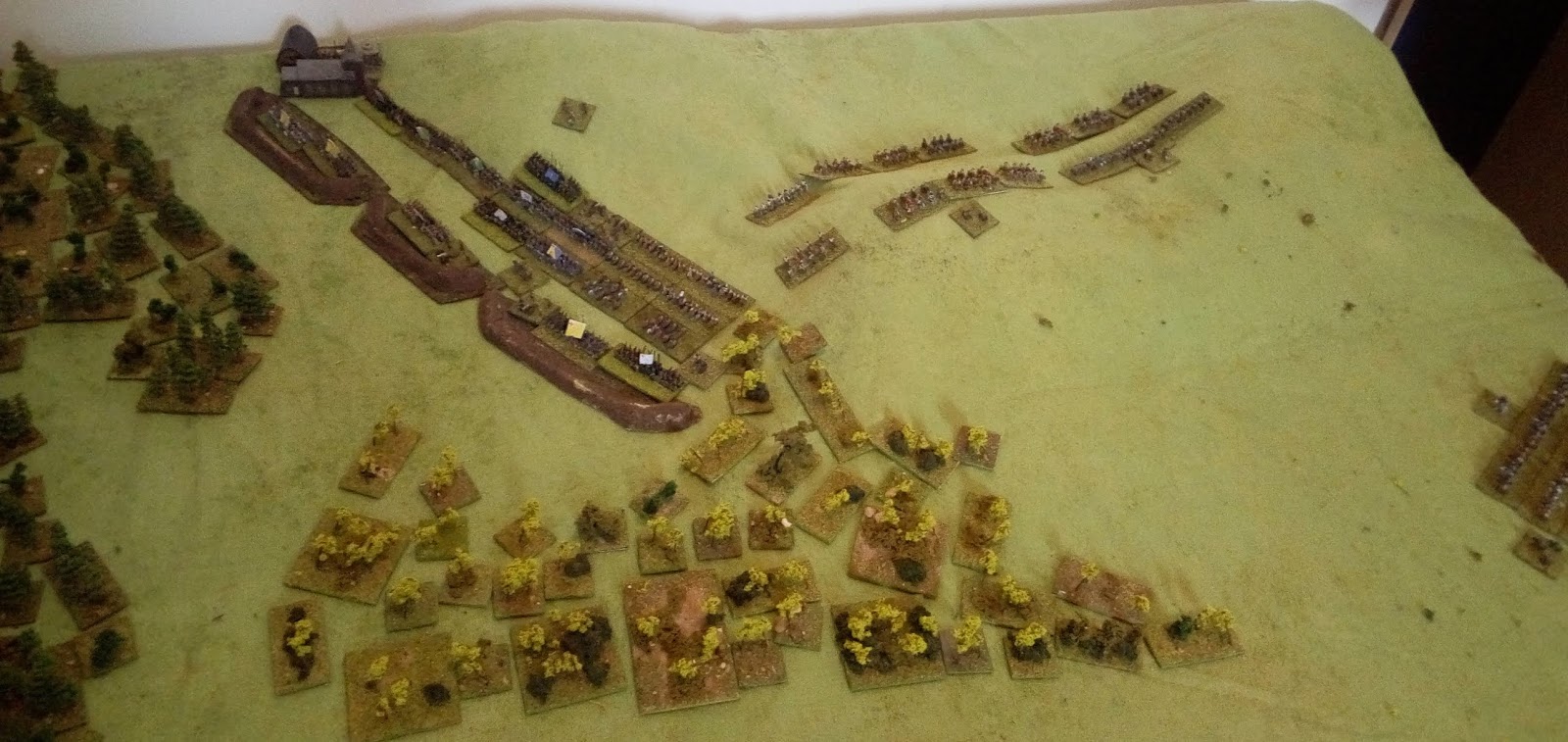
The Franco-Savoyard forces are deployed in fortifications around the town (centre) and on the far bank (top-right)

A closer look at the forces occupying the town and earthworks.

Vittorio Amedeo and his main body are on the other side of the river from the fortifications

Another view
The Battle:
The Spanish Army has arrived: the Foot has deployed in the centre with Horse in support.  A second mixed column is moving along the hills (top), and another brigade of Horse is moving to secure the other flank (bottom-right)

The deployment is completed.  The Franco-Savoyard main body (top-left) has still not moved

The massed Spanish Foot begins its advance

The assault on the fortifications begins: the main Spanish infantry force arrives first (centre-right)

The Spanish force on the right begins its assault too, attempting to clamber over the earthworks in the face of musketry fire

Initially, the Franco-Savoyard defenders hold their ground quite easily

Spanish Horse joins in the attack (bottom)

The Spanish army is engaged all along the fortifications but has not broken through, although casualties on both sides are mounting, especially in the earthworks at the base of the hill (centre-top); the Franco-Savoyard main body has got moving and its lead unit is across the bridge (top-left)

Finally Spanish pressure begins to tell and a Franco-Savoyard regiment goes under, creating a gap in the defences (centre); losses on both sides continue to mount elsewhere

Franco-Savoyard units are suffering at an increased rate and there is a definite gap now (centre): can the Spaniards exploit quickly enough?

...or has Vittorio Amedeo managed to get his reinforcements into place in time?!

The Franco-Savoyard defences against the Spanish Right are overwhelmed; the French cannot deploy quickly enough to restore the situation

The gap in the defences is widened in the centre (centre-right) and the Spanish Foot pours inexorably forward...

The Franco-Savoyard defenders continue to inflict heavy losses on the Spanish attackers even after they have passed over the walls

The advancing Spanish have managed to reach the village and are attacking its defenders (centre-left)

The leading Franco-Savoyard reinforcements have been taken in the flank an are being pushed back towards the bridge

The position of the red flags shows how far the Spaniards have managed to advance (and the fortifications at the bottom of the village (bottom) where they haven't managed to get forward at all); at this point the Franco-Savoyard forces became discouraged and the battle was lost!

Game Notes:
Not much to say about this one: good game, good scenario (although once again there are a couple of errors in the commanders for the scenario, you need to have a look a the errata sheet).  It was quite tight, tighter perhaps than the visuals made it look: the key moment was that the relieving Franco-Savoyard column of Foot failed two action rolls to re-deploy.  This gave just enough time for the attacking Spanish right wing to finish off their opponents on the defences and advance to catch the leading reinforcement regiments in column and defeat them.  This in itself didn't cause defeat, since morale is tested by 'command' or 'wing', but it meant that the defending force couldn't be relieved before it lost so many units that it was defeated, leading to the defeat of the whole.  As I think I have mentioned before, the command and army morale mechanism works a little like DBA and Polemos (in the Napoleonics version), in which a certain number (half) of individual units being defeated will lead to the defeat of a wing, and the defeat of half of the component wings will lead to the defeat of the army.  It is a very little bit  more complex than that, but that is the essence.  Like the rest of the mechanisms, it seems to give a believable result: in fact, thus far, I haven't found any mechanism or factor that seems out of place, although I am not confident in the period to be sure about the calibration and I still have a couple of "am I doing this right?" questions for the forum.  I did add a ruling which seemed reasonable, that troops that hadn't crossed the defences couldn't be counted as being in position to create negative modifiers for defending the flank or rear.  This seemed more fair than not.

Played on a 3'x2' area, using Baccus 6mm ECW armies as proxies and with Leven buildings.

Sunday, 14 April 2019

Battle of Wittstock 1636 - a Twilight of Divine Right AAR

The next Thirty Years' War battle I have attempted with the Twilight of Divine Right rules was the Battle of Wittstock, again from the scenario in the accompanying book.


Wittstock is an interesting and unusual scenario, since it features an attack by the Swedish/Protestants on one flank then an attack on the other flank later on.

Summarized Order of Battle:

Swedish/Protestant Army:
C-in-C: Baner
Vanguard
12 units of Horse

Centre (reinforces the Vanguard):
5 units of Foot
2 units of Guns

Flanking Force:
8 units of Horse
1 unit of Dragoons
3 units of Foot

Imperial-Saxon Army:
C-in-C: Elector Johann-Georg

Left:
14 units of Horse

Centre & Right:
6 units of Horse
1 unit of Dragoons
14 units of Foot
4 units of Guns

The order of battle in the scenario book is much more detailed than this, in ways that do make a difference to the game.  This is especially true for the Imperial-Saxon side, since they re-deployed elements of the their force in specific chunks to face the Swedish threat.

The Scenario:

The Imperial-Saxon army is set-up in one direction, in entrenchments.  They are then faced by a Swedish force turning their left flank, and two contingents of Horse have been dispatched to face them.  There are a couple of different ways offered to replay this in the scenario book.  I selected the scenario when the first two Imperial-Saxon forces have already moved and Baner's Swedes are ready to attack.  However, after 10 turns, another Swedish flanking force turns up facing the edge of the Imperial-Saxon right wing; although the exact turn of arrival is diced for.  Then, more Swedish-Protestant infantry will turn up to reinforce the Swedish vanguard.
As a self-imposed rule, I forbade the Imperial-Saxon forces from advancing beyond their line of entrenchments before the arrival of the Swedish-Protestant flanking forces: it seemed unlikely and unfair to allow a re-deployment on this flank to face a basically unknown threat.

The Set-up:
The main Imperial-Saxon position is to the left behind entrenchments; the re-deployed force is on the high ground to the right whilst the Swedish vanguard has just entered (bottom-right)

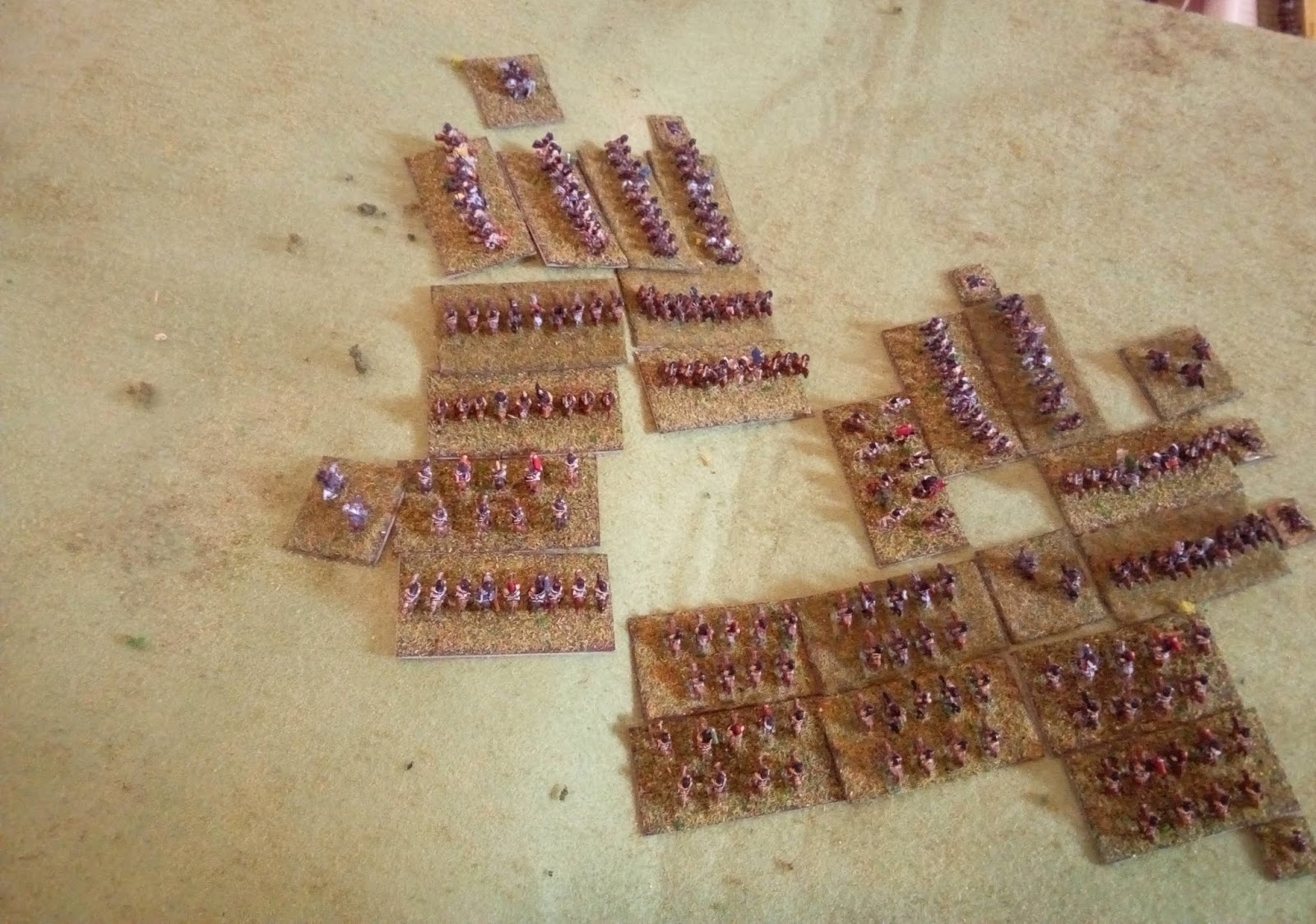
The main Imperial-Saxon army behind its entrenchments

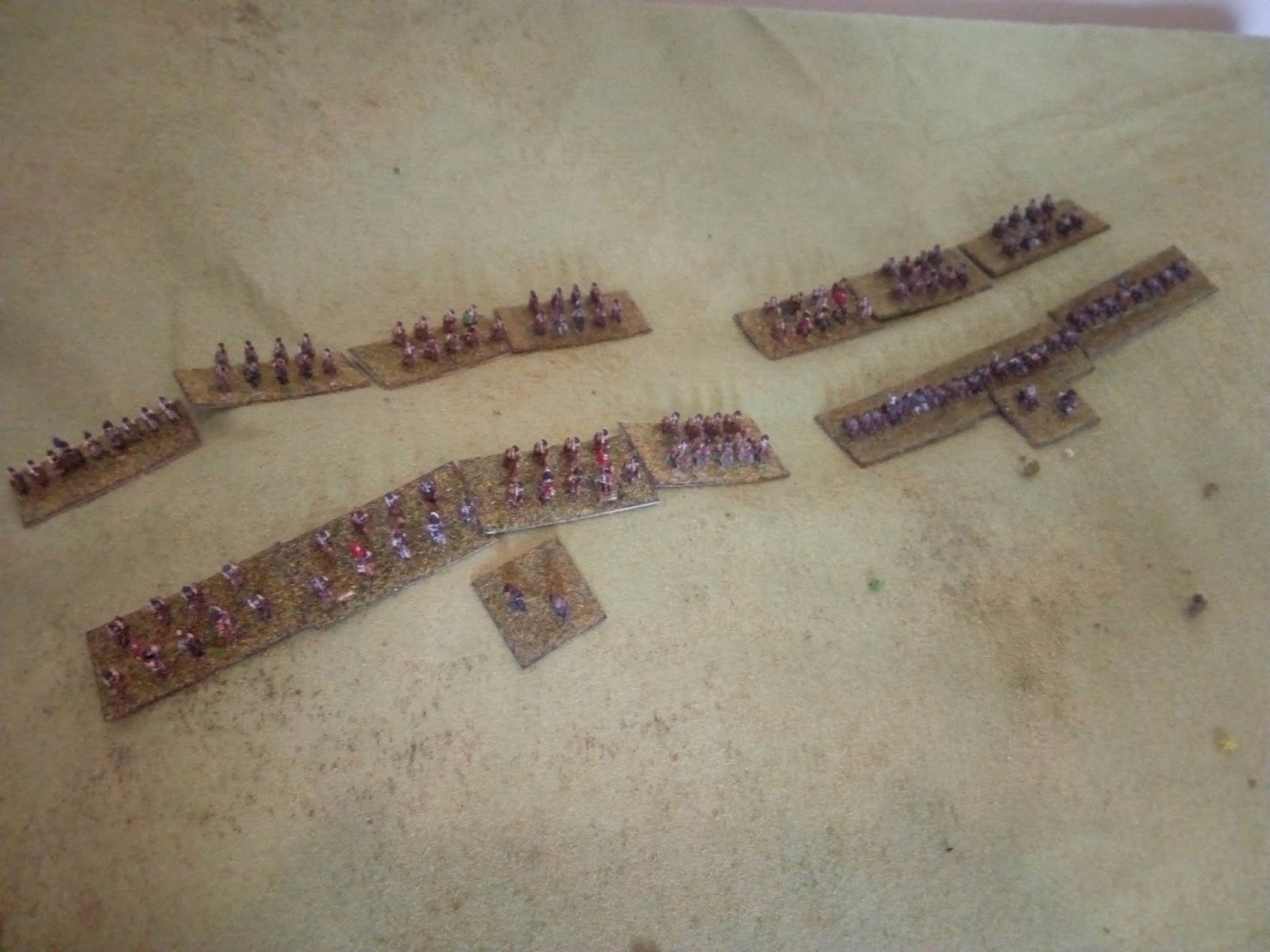
The Imperial-Saxon Horse

Baner (right) supervises the advance of Torstensson's Horse
The Battle:
Why waste time?  Baner organizes his Horse and advances; the Imperial-Saxons feel their hand is forced and get their retaliation in first, ordering a charge

First blood to the Imperials: the Swedish Horse start to take some losses (see casualty markers in Swedish front rank)

After a couple more turns of fighting, the situation has become more confused: however the Imperialists are doing quite well and more importantly, have got an organized forces around the Swedish flank (bottom-left quarter)

Elector John-George gets a detachment of Foot and Guns from his main body on the march to support the left wing

The melee continues: this time the Swedes get their charge in first to forestall an attack (centre)

Notice in the centre that the Swedes are doing quite well and have reached the higher points of the slope (top)

And...breakthrough!  The Swedes have split the Imperial-Saxon Horse in two...

Surely the Swedish left cannot hold under such pressure (bottom and centre)?

They are being pushed back, but are still basically holding out

Torstensson makes sure that he finishes the business at hand, trying to secure the slopes before helping his beleaguered left

The wider position: there are a couple of uncommitted units of Horse about to be committed by the Imperial-Saxons (centre), whilst the foot column just hoves into view (top-left)

The melee continues.  Things are beginning to look a bit bleak for the Imperial-Saxons though: they have failed to take advantage where they were strongest (foreground) but the Swedes have polished off the left-wing of the Imperials quite smartly and will soon be able to use these troops to help out

And so it is proving; the final two Imperial-Saxon Horse units charge in (left) since this is the last moment of near parity...


But without any great effect.  Torstensson will now be able to bring his victorious cavalry (top) into action onto the turned Imperialist flank

Some of the Swedish Horse units have been eliminated (see gap in centre) but their line of Horse has been reformed


But still the cavalry combat rages on...

The Imperial-Saxon foot column gets into position

The last Imperial Horse units are under heavy pressure...

When like a bolt from the blue, the Swedish-Protestant flanking force arrives! 

Hoping to keep the pressure on and trusting in the remainder of his Horse to triumph in the main melee, Torstensson charges with his victorious Horse straight into the line of Imperial-Saxon Foot, hoping to catch the rear elements (bottom) still in column of march...

Meanwhile the flanking force, attacking with great elan, has forced its way into the fortifications (centre)

The Swedish Horse make a dent in the line of Imperial-Saxon Foot and do catch a couple of units still in column

The remainder of the Swedish Horse are slowly grinding their opponents into dust...

The battle rages on the right flank of the fortifications: the Imperials have lost some men in the fighting, but musketry from the flanks is causing the Swedish cavalry some losses too

The Imperial Horse on the left has been broken through and is on the point of collapse...

Having got into the position with great dash, the Swedish Horse is finding it difficult to cling on in the face of fire from three sides...

Losses on both sides in the battle between the Swedish Horse and Imperialist Foot for possession of the hill

Only scattered remnants of the Imperial Horse (bottom-centre-top) are still in the fight, although those that are are fighting hard


Some of the Imperialist Foot are proving tough opponents for the Swedish horsemen

Neither side is yet able to change the stalemate around the fortifications; an attack on the village (top) has been driven back with loss and the Swedish dragoons have dismounted (top-left) to try again on foot

Swedish infantry reinforcements arrive (top) and attack the Imperialists defending the buildings, but they are not to be moved!

Losses increase in the centre of this fight on both sides, without anything much being achieved...

However, the Imperialist infantry on the other flank has been attacked and routed by more Swedish cavalry (bottom and right)

Imperialist morale collapses as their left wing collapses...probably most of the remaining Imperial-Saxons can escape, since they have a body of uncommitted cavalry (centre)
Game Notes:
More good fun, and a very interesting scenario.  I remember looking at a scenario for Wittstock in Miniature Wargames 53 a while ago as part of my series of refighting scenarios from old magazine articles, but it didn't seem to me to actually be workable as a game, regardless of its merits or otherwise as an historical article.  I think it was one of the kinds of articles that Wargames, Soldiers and Strategy and Battlegames were a bit of a backlash against.  Anyway, I digress! 


The battle was close and I think the Swedes were lucky.  The Imperialists' manoeuvring was better, although let down by some tardy unit execution on occasion, but the luck of the dice was with the Swedes and sometimes that makes the difference.  On a tactical level again, there was nothing that seemed wrong, according to my admittedly limited understanding of the basic 'grammar' of the fighting of the period. 
That said, this is the game of the three in which I have had most little struggles with the rules.  This seems to have been a direct result of the circumstances, which encouraged a big, flowing cavalry fight.  I made a couple of mistakes myself, which didn't help, although I don't think they materially affected the outcome.  I struggled with two related areas:
1 - Which actions can a unit in combat perform, in particular if it is contacted in the flank or rear, presuming it survives the first round?  For instance, are columns hit in the flank, stuck in that formation, or subject to a successful action test, can they deploy?  Or are they assumed to come out of column automatically?  Since there are circumstances in which troops definitely can take action tests in combat, the second seems most natural (in the rules); but, would doing that move conflict with the "you can only advance directly towards that unit" rule in the zone-of-control section?  I am not sure.
2 - How do turns to flank work?  Are they like in Polemos, which has to be done by wheeling?  Or in Neil Thomas' rules, where you pivot from the centre?  Or can you basically do either, like in DBx?  This ends up making a lot of difference, potentially, to how flank attacks play out.
Anyway, this is reasonably marginal stuff and I made on the fly rulings according to how I thought the rules intended to go (the joys of solo gaming!) but I genuinely wasn't quite sure if I had picked the right options here.
Although the scenario as a piece of game design is very good, as a piece of writing it wasn't great, with a couple of quite confusing bits.  For example, it says that "at the start of the game,  King's and Vitzhum's commands are flank marching.  The Swedish player chooses which turn they will start to roll for their arrival".  The orders of battle have Vitzhum on the Imperial-Saxon side commanding their Foot in the entrenchments.  Is the Swedish player really meant to roll for his arrival?  The Swedish order of battle doesn't contain King at all, expect to mention that Kornis' Reserve command is under 'the King's' command. Is 'King' the same as 'the King'?  That might sound weird to read, but it actually makes equal sense to read it either way. The text doesn't mention what Shlick's Swedish Cavalry force are meant to be doing.  I am guessing that they are actually the force which arrives first with King (or 'the King').   So I made my best guesses, and the old MW053 article plus the Wikipedia entry helped a bit here, but I could have got the designer's intention quite radically wrong!  Please let me know if this is the case, any TYW experts out there.  Also the map wasn't clear if there was meant to be a village where I placed it.  It looks like the symbol for village is there, but it isn't named, so perhaps I have misinterpreted this.
Anyway, all that said, it was another very enjoyable game - recommended.  Played over a slightly bigger area than normal: 4'x2.5', using Baccus 6mm figures from my ECW armies and Leven buildings.